
𰀲𰅐𰄣'𰆄 𰀴𰅃 𰂆𰆆, 𰀳𰂐V𰀅!
What the hell does a media arts curator do?
Doreen Ríos, media art curator and recipient of the 2026 Error 415 grant, reflects on building spaces for digital art with a focus on Mexico and Latin America. Moving between personal experiences, curatorial collaborations and a recent program for emerging Latin American media arts curators, she shares insights into the often invisible labor, challenges and collective efforts that make these practices possible.
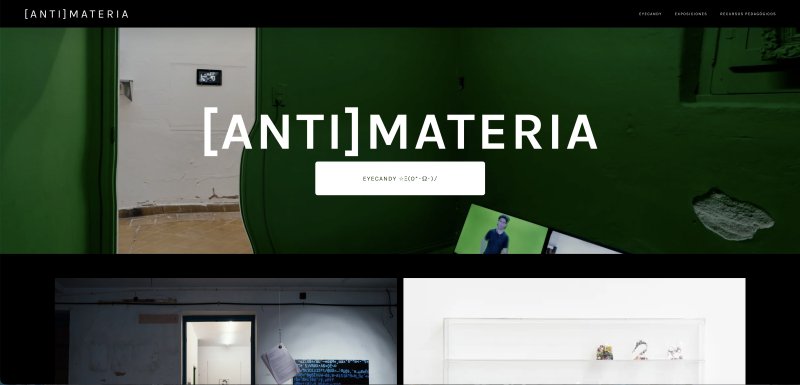
When I started [ANTI]MATERIA in 2015, I was trying to prove to my (former) boss, the editorial director of an arts, design & architecture magazine, that there was a growing community dedicated to digital art practices in Mexico and that we should be writing about it. He was not convinced. In his view, the community wasn't there, the work wasn't serious, and the whole thing was a niche interest not worth the pages. So I did what you do when you have no institutional support and a lot of stubbornness (also a student email account that still gave me some freebies here and there)...I made a website. The original goal was to gather art professionals interested and/or working with digital art practices in an e-directory, as proof that the circuit existed. Spoiler alert: I never wrote that essay. But the excuse gave me a reason to keep going.
The original goal was to gather art professionals interested and/or working with digital art practices in an e-directory, as proof that the circuit existed.
My first intuition, apart from a deep Internet swipe, was to reach out directly to the people who kept popping up in my searches and ask them for an interview. This was how I met Paty Siller. She was (and is) kind, fun, radically honest, and very, very fierce. At the time, she was the Production Director for MATERIAL Art Fair and also had a strong independent curatorial practice. In the interview, she shared her insight on how digital art practices gained very little attention from collectors and commercial galleries despite the growing interest in the field by artists. I remember we spent a good amount of time talking about the challenges of putting forward curatorial projects that touched on pop culture, since they were generally perceived as less rigorous or relevant to the intellectual elites of contemporary art.
A common thread ran through the interviews I conducted in those early days of [ANTI]MATERIA, one that could be summarized as the lack of opportunities to exhibit digital artwork, and the consequences that follow from it. No exhibitions means no documentation, no archives. No archives means no material to build research from. And no research means no history-making. Nothing to piece these stories together into something that could be cited, taught, or remembered. It's a self-reinforcing loop that makes the field stay perpetually young, perpetually starting over.
While it might have seemed a bit useless to take matters into my own hands, I also knew I could, at least, harness one of the Internet's promises and build the space I wished for, despite it being small. However, I didn't fully understand the role I could play within this community (yet). I knew I didn't want to be an artist, but with so little experience, I wasn't sure what else I could be. Starting [ANTI]MATERIA and engaging with the challenges this community faces, I slowly, but surely, realized that the curator—uncool power figure or not—was what best aligned with what I could add to the mix.
While it might have seemed a bit useless to take matters into my own hands, I also knew I could, at least, harness one of the Internet's promises and build the space I wished for, despite it being small.
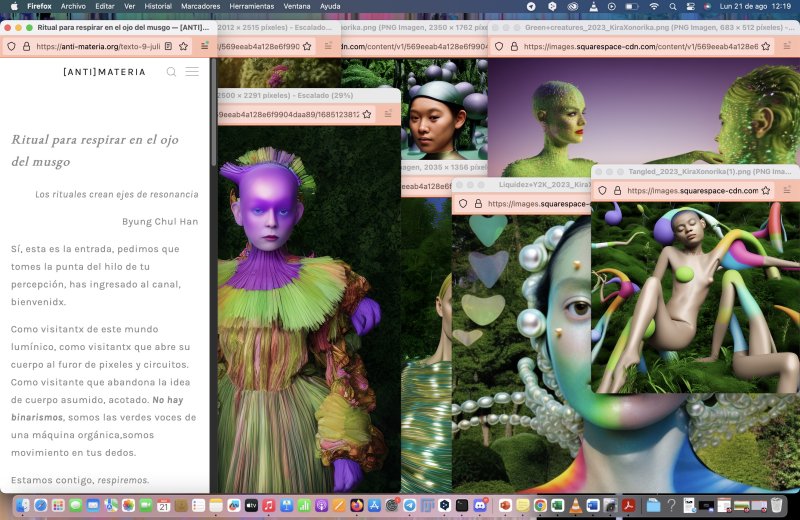
This realization pushed me to explore a new layer in [ANTI]MATERIA and transform it from a directory into a directory and exhibition platform, so that the work could at least begin to get archives somewhere. Since then, I have run [ANTI]MATERIA as founder and curator with a particular interest in technological counterproduction, tactical media, and new materialities. It has since expanded its site-specificity and it now encompasses a weekly blog called Eyecandy, which showcases exhibitions and projects from around the world dealing with technical objects as well as a repository of various research materials, and an exhibition component that hosts online, offline and hybrid shows. What makes it different, I think, is that it focuses in nuestra América Latina—not as an afterthought or a translation layer, but as the default. That impulse is what Paty and I have shared ever since.
While I was building [ANTI]MATERIA into a platform, Paty had co-founded Janet40 (2016–2022) with artist Luis Nava, a curatorial duo based in Mexico City that emerged as a direct response to the (institutional) circuit's disinterest in digital practices. With Janet40, they worked hand in hand with artists who originally used digital technical objects to make their work, producing what they called "souvenirs from the Internet"—furniture, clothing, beach towels, toys, perfumes—as a way to explore the experience around the digital and, above all, to escape the obvious and avoid just printing stuff altogether. It was a project that took the (supposed) immateriality of digital art and gave it weight, texture, and a kind of mischievous physicality. You could hold it, wear it, smell it. And in doing so, it asked what it actually means to experience the digital, beyond the screen.
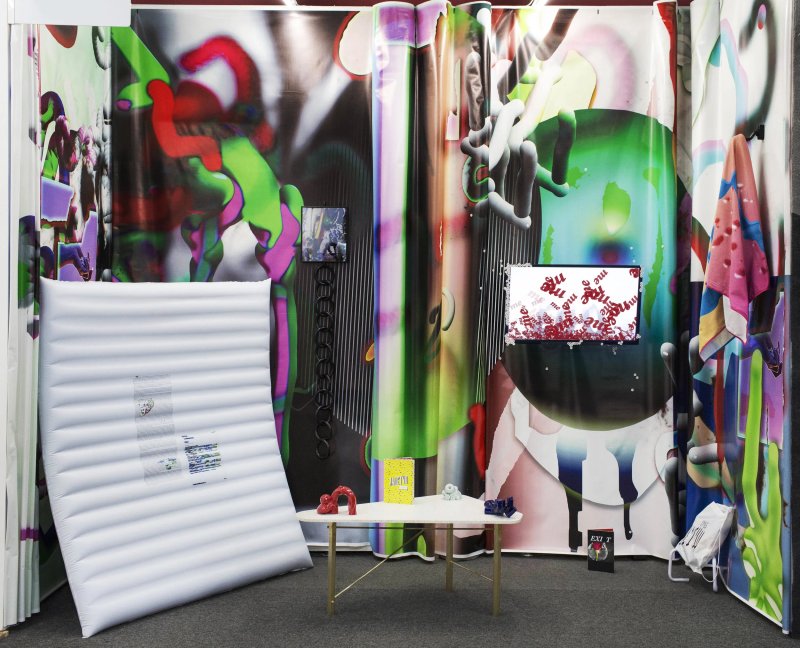
With Janet40, they worked hand in hand with artists who originally used digital technical objects to make their work, producing what they called "souvenirs from the Internet"—furniture, clothing, beach towels, toys, perfumes—as a way to explore the experience around the digital and, above all, to escape the obvious and avoid just printing stuff altogether.
Janet40 leaned into the art market, offering artists working with digital media a way to sustain their practice through selling their work; it worked on the ground, as opportunities and resources allowed. [ANTI]MATERIA took the research side of things, archiving, publishing, building the discursive ground these practices need to be studied and remembered. This difference also marks our respective careers and experiences, and they complement each other. Paty's trajectory—production, fairs, galleries, collective organizing—taught her how to navigate the market, how to negotiate with institutions, how to make things happen within the existing structures. Mine—writing, archiving, teaching, the slow work of building a discourse—taught me how to make the case for these practices in language that could travel beyond the immediate moment. Neither path is sufficient on its own but, together, they form a kind of two-legged stool. Wobbly, but standing. Now, truth be told, both paths are precarious and require a certain tolerance for institutional indifference. But both are possible, and that possibility matters.
I have always had a deep admiration for Paty—not just for her sharp eye and her refusal to pretend that everything is fine when it isn't, but for the way she moves between production, curation, and mentoring without ever losing sight of the people and the work. Back in 2015, she immediately pointed out a series of differences between the hegemonic figure of the curator within museum practices and curatorial studies at large, and that of the people who, like us, were specifically looking at digital art practices. Paty did attend art school, but she grew up in Saltillo—far from the centralized regions of cultural power—and that distance gave her a different vantage point on what a curator could be. I could see myself reflected in her experiences, having grown up in yet another industrial city, Toluca, perpetually obscured by the beautiful monster that is Mexico City.
What the hell does a media arts curator do?, how is it different from other curatorial practices?, and how do I become one?
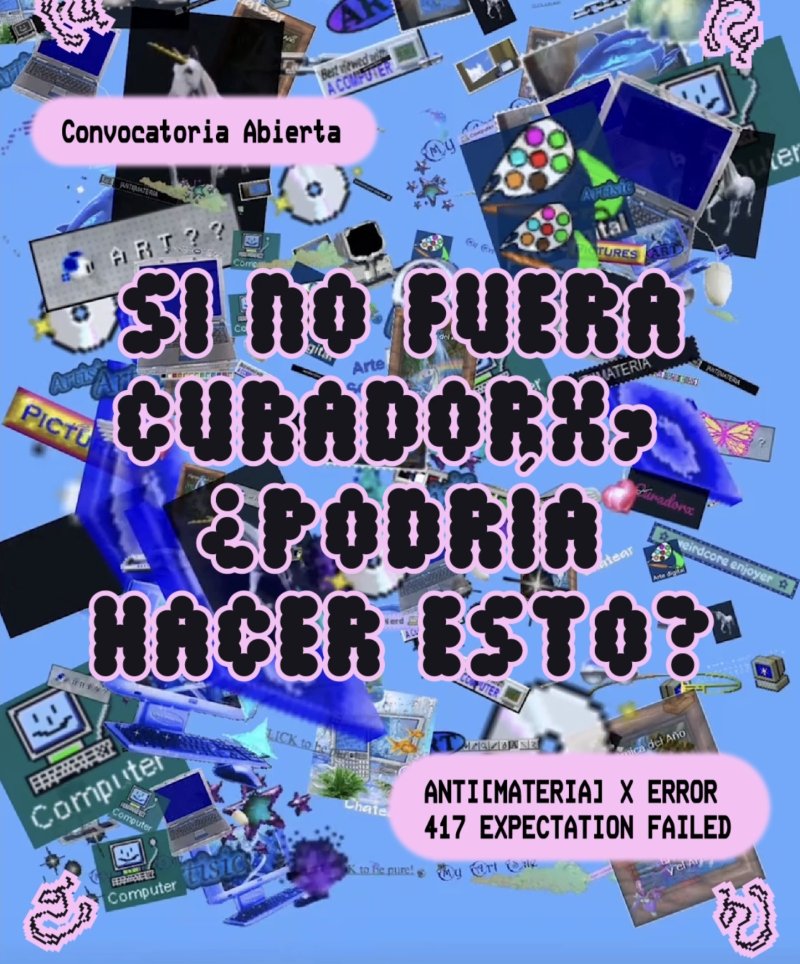
That conversation stayed with us for eleven years, even if we didn't know what to do with it yet. This past summer, thanks to the generous support of Error 415 Unsupported Media Type, after many exhibitions, rants, and a lot of self-deprecating humor (just the right amount to keep sane in an increasingly precarized field), we finally got together to design a curatorial workshop for emerging Latin American curators interested in media arts. By now, digital art seemed to be little by little escaping its silo within contemporary art, so we expanded the frame to media art at large. We titled it Si no fuera curadorx, ¿podría hacer esto? (If I wasn't a curator, could I do this?) and from the start we knew that we wanted to address the things we would have loved to know when we started, all the things we had to learn through (deeply frustrating) experiences, and those that were too taboo to be discussed in public, such as budgeting, agreements, institutional negotiations, payments, and fees. It was a program designed to teach curatorial methods, but, most importantly, to make visible the labor and infrastructure that sustains it, the machinery that keeps projects alive.
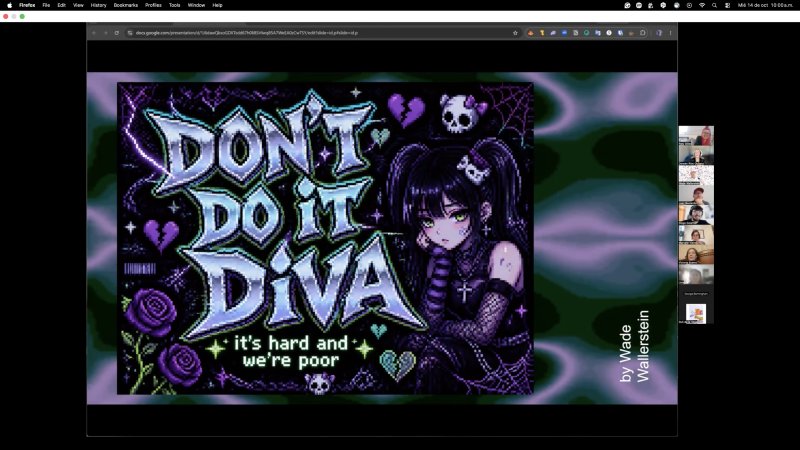
The program addressed three questions: what the hell does a media arts curator do?, how is it different from other curatorial practices?, and how do I become one? Of course, these aren't questions you can answer in the abstract—they only make sense when you're in the room with people who've actually done the work, made the mistakes, and lived to tell the tale. So we invited guests we both admire—Pita Arreola, Dr. Omar Kholeif, and Wade Wallerstein—who openly, and with a lot of care (and some tough love), shared their experiences, good and bad, exploring the things that worked but also the things that went wrong.
Over the course of ten weeks, ten curators in the making from many corners of Latin America—Ángel, Duli, Frisa, Alana, Diego, Hienas (Caro & Georgia), Sollozo, Lo, Mariví, and María Jesús—shared with us their concerns and frustrations, their hopes and dreams. We talked about the projects that fell apart, the institutions that ghosted us, the funding that never came through, but also the moments of genuine discovery, the collaborations that spilled outside of the original goal, the quiet satisfaction of building something that didn't exist before. It was generous, unglamorous, and exactly what we needed. Every person that was part of the program taught us as much as we could ever teach them, and we're still grateful for every bit of it (we miss you!).
Beyond following academic standards and its way of measuring the success of a pedagogical program, if there's one thing we took away, it's this: you become a media arts curator not because it's practical, or lucrative, or even particularly respected, but because you can't quite imagine doing anything else—and because, every so often, someone else shows up who feels the same way, and you build something together, however small, however precarious, however unlikely to last. If you're lucky, one day you find your Paty. And then you do it all over again.
Doreen Ríos

Doreen Ríos has been documenting and shaping the contemporary media art scene with her platform [ANTI]MATERIA since 2015, through which she publishes online exhibitions, essays and research, as well as a weekly column focussing on current projects, mainly from Mexico and Latin America. Doreen Ríos' work focuses on technological counterproduction, tactical media, and new materialities. Ríos is the founder of [ANTI]MATERIA, an online platform dedicated to the study and exhibition of art produced through digital media.
From 2019 to 2021, she served as Chief Curator at the Centro de Cultura Digital in Mexico City. Recent curatorial projects include Vanishing Acts at the Taipei Fine Art Museum (2025-2026) and Postborder (code)pendency at Rhizome (2025). Her critical writing has been featured in publications such as Media Arts 21, Luna Córnea, and the Brooklyn Rail. She is the author of Medios inestables. De objetos técnicos y arte (2025).
Currently a PhD candidate in Art History, Theory, and Criticism at the University of California, San Diego, she is also a member of the Leonardo Peer Review Panel as well as the International Selectors Committee for the Lumen Art Prize.
Based in: San Diego, US